
23 moments
Born in Zou
· Zou, near Qufu, Shandong, China
Confucius was born in the domain of Zou, traditionally dated to 551 BC. Zou lay near modern Qufu in the state of Lu. The traditional date is sometimes given as 552 BC. Coordinates represent the traditionally identified Zou/Nishan area southeast of Qufu.
Visits the ruler of Tan
· State of Tan, present-day Tancheng, Shandong, China
According to the Zuo tradition, the young Confucius visited the ruler of Tan to learn about ancient bureaucratic titles, illustrating his early pursuit of ritual and historical knowledge. The episode is a traditional account. Coordinates represent modern Tancheng, associated with the ancient state of Tan.
Answers Duke Jing in Lu
· State of Lu, present-day Qufu, Shandong, China
While Duke Jing of Qi and Yan Ying were visiting Lu, Confucius answered the duke’s question about how Duke Mu of Qin had achieved hegemony. The source specifies the state, not the meeting venue. Qufu, Lu’s capital, is used as a representative point.
Seeks service in Qi
· State of Qi, representative point at Linzi, Shandong, China
Following Duke Zhao of Lu’s flight, Confucius went to Qi and reportedly entered the household of the nobleman Gao Zhaozi. The source establishes presence in Qi but not a precise site. Coordinates represent Qi’s capital, Linzi.
Returns to Lu
· State of Lu, present-day Qufu, Shandong, China
Confucius returned to his home state after his early sojourn outside Lu. The source identifies Lu generally; Qufu is used as its representative capital.
Governs Zhongdu
· Zhongdu, present-day Wenshang, Shandong, China
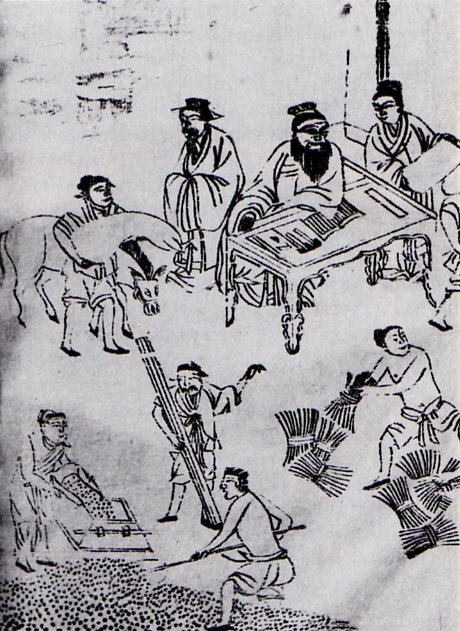
Wikimedia Commons · Public domain · file Traditional chronology places Confucius as chief magistrate of Zhongdu, an early stage in the official career later attributed to him. The identification of ancient Zhongdu with modern Wenshang is traditional; the extent of Confucius’s official career is debated.
Represents Lu at Jiagu
· Jiagu, State of Qi, present-day Shandong, China
At the diplomatic conference of Jiagu between Lu and Qi, Confucius was credited with defending Lu’s ruler and ensuring observance of proper protocol. The ancient meeting site’s modern identification is uncertain. Coordinates are a representative point in the traditionally proposed central Shandong area.
Departs Lu for exile
· State of Lu, present-day Qufu, Shandong, China
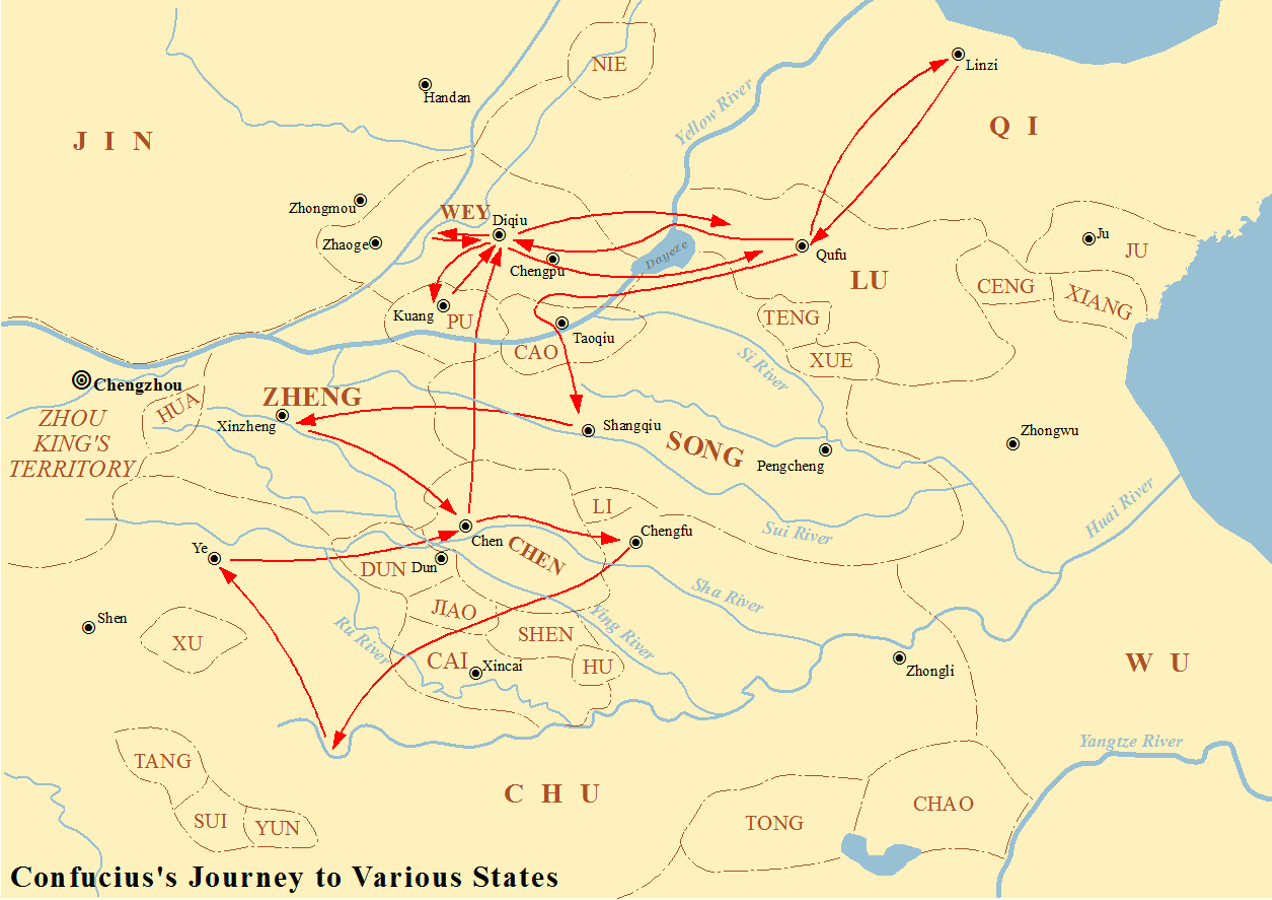
Wikimedia Commons · Creative Commons Attribution-Share Alike 4.0 International · file After the failure of political reforms associated with dismantling aristocratic strongholds, Confucius left Lu and began his prolonged travels among neighboring states. Some reconstructions place his departure in late 498 BC rather than 497 BC.
Lives in Wei
· State of Wei, representative point at Diqiu, present-day Puyang, Henan, China
During his first recorded stay in Wei, Confucius lived in the household of Yan Zhuozou, a relative of his disciple Zilu. The source identifies Wei and the host but not the exact settlement. Coordinates represent Diqiu, Wei’s capital.
Passes through Pu
· Ancient Pu, present-day Changyuan area, Henan, China
After the Kuang crisis, Confucius passed through Pu while moving through territory belonging to Wei. The year is reconstructed from the sequence following the first Wei stay. The ancient site is placed in the modern Changyuan area.
Stays with Qu Boyu in Wei
· State of Wei, representative point at Diqiu, present-day Puyang, Henan, China
Confucius returned to Wei and stayed in the household of Qu Boyu, a respected Wei official remembered in early traditions for principled conduct. The exact location of Qu Boyu’s residence is not identified. Coordinates represent Wei’s capital.
Surrounded at Kuang
· Kuang, southwest of present-day Changyuan, Henan, China
While traveling from Wei, Confucius was surrounded at Kuang after residents reportedly mistook him for an enemy associated with an earlier attack. The episode followed the initial Wei stay; assignment to 496 BC is a conventional reconstruction. The source locates Kuang southwest of modern Changyuan.
Arrives and lodges in Chen
· Chen, present-day Huaiyang, Henan, China
Confucius reached Chen and stayed with Shicheng Zhenzi, beginning a prolonged period in and around the state. Coordinates represent Wanqiu, the capital of Chen; the host’s residence has not been identified.
Passes through Cao
· Taoqiu, State of Cao, present-day Dingtao, Shandong, China
Leaving Wei for the south, Confucius crossed the small state of Cao on the route toward Song, Zheng, and Chen. The source identifies Cao as a waypoint. Coordinates represent Taoqiu, Cao’s capital near modern Dingtao.
Passes through Zheng
· Zheng, present-day Xinzheng, Henan, China
Confucius crossed Zheng during his southward journey. Tradition says that he became separated from his disciples there and waited alone near the eastern gate. Coordinates represent Xinzheng, the capital of ancient Zheng; the precise gate site is not securely established.
Leaves Pu for Wei
· Ancient Pu, present-day Changyuan, Henan, China
On a later passage through rebellious Pu, Confucius eventually departed the district and continued back toward Wei. The source identifies Pu with modern Changyuan. The year follows a traditional reconstruction of the journey.
Remains in Chen
· Chen, present-day Huaiyang, Henan, China
Confucius remained in Chen during the year following his arrival, lodging with an official associated with the city wall. The older romanization Ch‘an denotes Chen. Coordinates represent its capital, Wanqiu.
Practices rites under a tree in Song
· Ancient Song City, southwest of Shangqiu, Henan, China
At Song, Confucius and his disciples practiced ritual beneath a large tree. The Song officer Huan Tui reportedly threatened him and uprooted the tree. Other reconstructions place a passage through Song around 495 BC. Coordinates represent the archaeologically identified Song capital southwest of modern Shangqiu.
Besieged between Chen and Cai
· Wilderness between Chen and Cai, present-day southern Henan, China
Confucius and his followers were surrounded in the countryside between Chen and Cai and cut off from food. The episode became a major illustration of steadfastness under adversity. The exact site and year are disputed. Coordinates are a representative point in the broad Chen–Cai border region.
Visits the Duke of Ye
· Ye, present-day Ye County, Henan, China
Confucius visited Shen Zhuliang, the Duke of Ye, in the northern Chu domain. Their discussions about government and Confucius’s character are preserved in the Analects tradition. Coordinates represent modern Ye County, associated with the Duke of Ye’s ancient fief.
Returns home to Qufu
· Qufu, State of Lu, Shandong, China
After roughly fourteen years of travel, Confucius returned to Lu and spent his remaining years teaching and transmitting older textual and ritual traditions. One modern scholarly reconstruction cited elsewhere places the return in 485 BC; 484 BC is the more common traditional date.
Buried beside the Sishui River
· Tomb of Confucius, Cemetery of Confucius, Qufu, Shandong, China
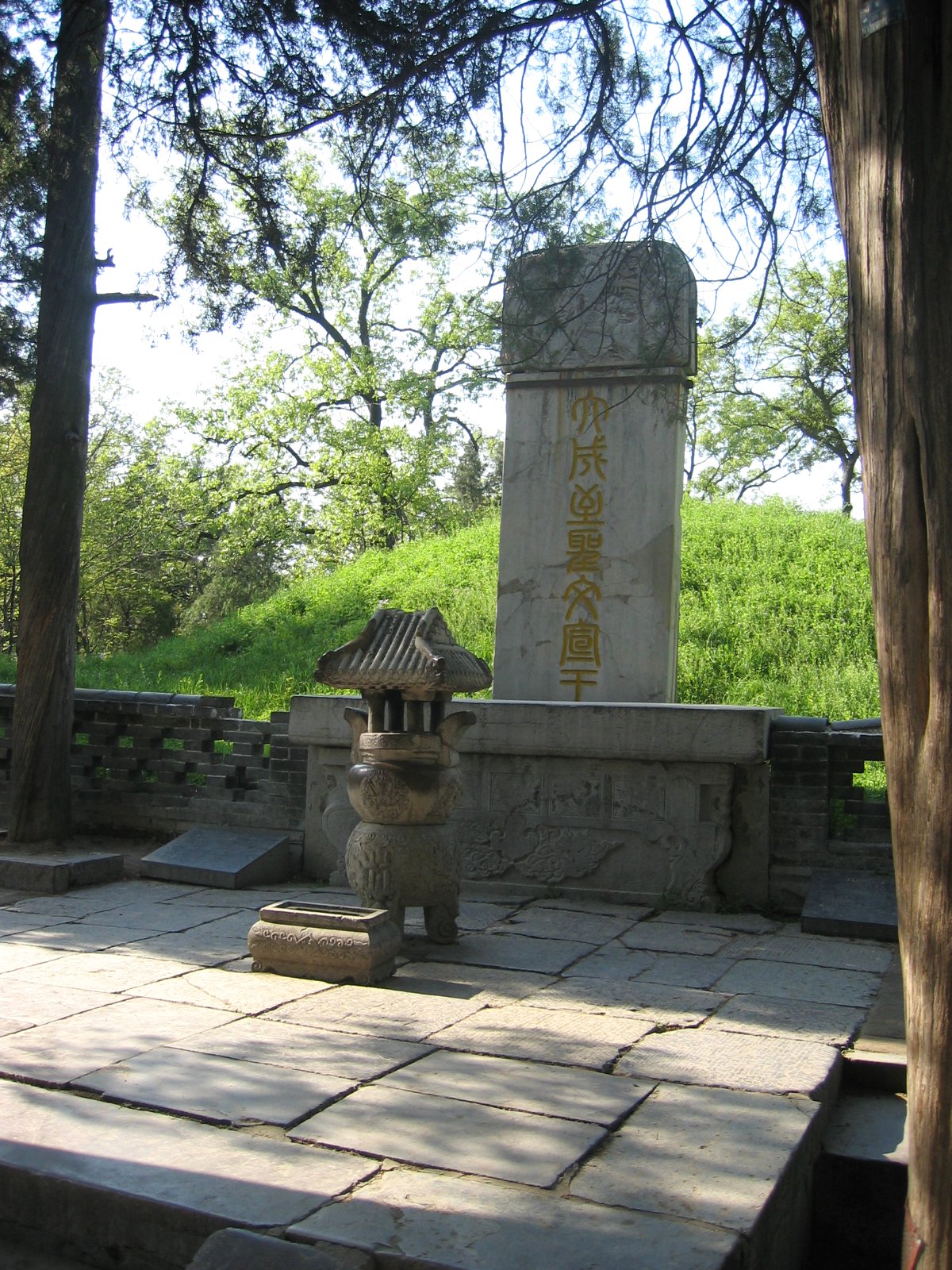
Wikimedia Commons · GNU Free Documentation License, Version 1.2 or any later version; Creative Commons Attribution-Share Alike 3.0 Unported · file Confucius was buried north of Qufu beside the Sishui River. His grave became the nucleus of the Cemetery of Confucius, the burial ground of generations of his descendants. Coordinates identify the surviving tomb area within the Cemetery of Confucius.
Dies in Lu
· State of Lu, present-day Qufu, Shandong, China
Confucius died in his home state after spending his final years teaching. The Spring and Autumn Annals records his death in the sixteenth year of Duke Ai. The source establishes Lu but not a particular building or settlement; Qufu is used as the representative point.